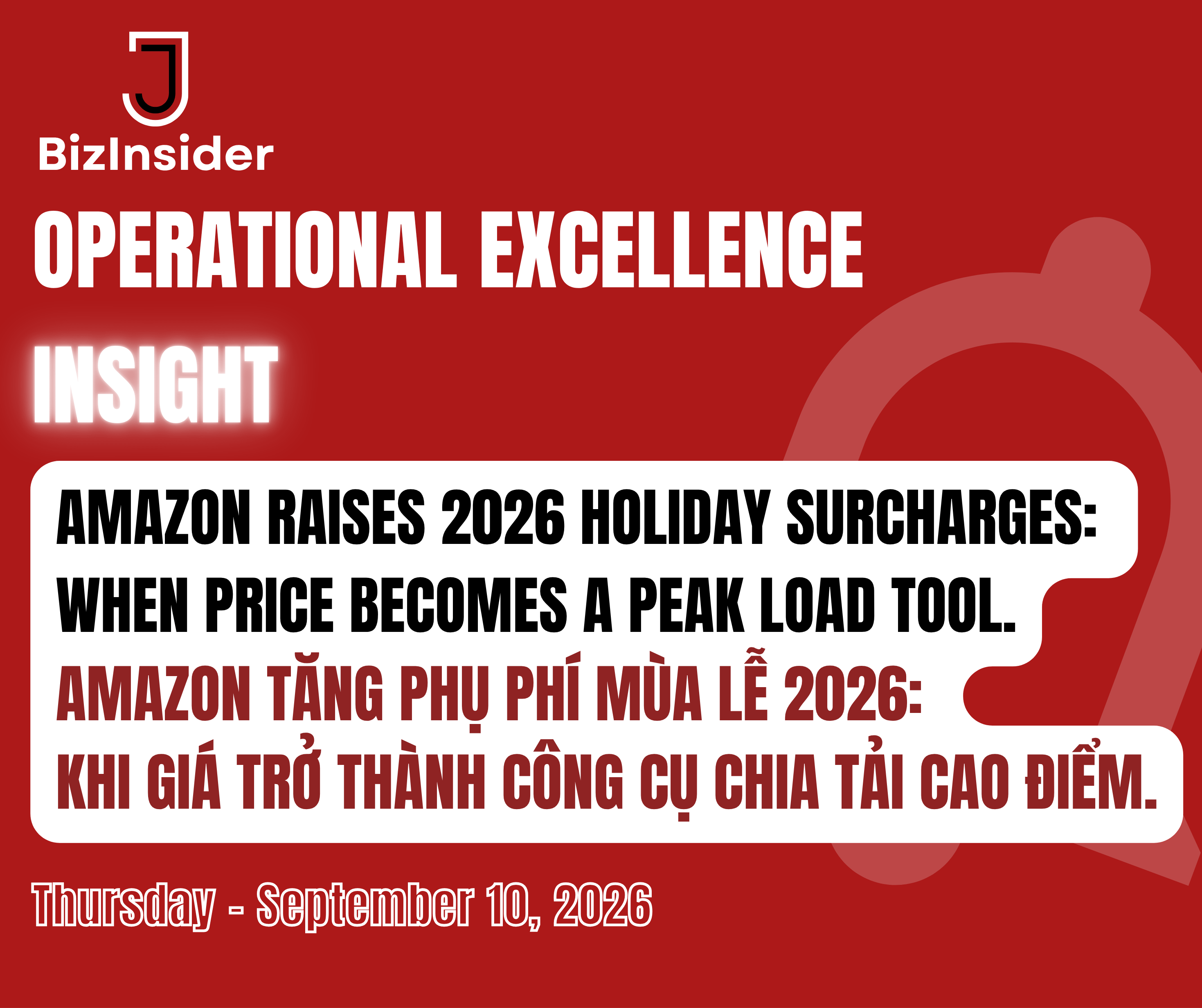
Operational Excellence (OPEX) Insight – Thursday - September 10, 2026: Amazon Raises 2026 Holiday Surcharges: When Price Becomes A Peak Load Tool.
Góc Nhìn Vận Hành Xuất Sắc – Thứ Năm, Ngày 10/09/2026: Amazon Tăng Phụ Phí Mùa Lễ 2026: Khi Giá Trở Thành Công Cụ Chia Tải Cao Điểm.

Welcome To Operational Excellence (OPEX) Insight Article For The Paid Subscriber-Only Edition.
This is the bilingual post in English and Vietnamese. Vietnamese is below.
Đây là bài viết song ngữ Anh-Việt. Tiếng Việt ở bên dưới.
English
When a small surcharge speaks a whole philosophy of operations
On September 3, 2026, while most selling businesses were still busy preparing for the year-end shopping season, Amazon quietly published a schedule of surcharges. No press conference, no loud announcement, just an update notice sent to sellers and to customers using their shipping service. The content sounded very technical and dry: from October 25, 2026 through January 16, 2027, the Amazon Shipping service would apply a peak surcharge, highest in the window from November 22 to December 26, that is, exactly the stretch spanning Thanksgiving, Black Friday, Cyber Monday and Christmas. Specifically, the surcharge per package rises from 0.50 USD in the early period to 0.75 USD in the peak weeks, then falls back to 0.50 in the post-holiday period. The fees for items needing special handling jump from 8.75 to 11.90 USD, large items from 96.25 to 117.50 USD, and extra-heavy items from 530 to 590 USD. The reason Amazon gave was just one sentence: these fees are meant to maintain service quality and capacity during the highest-demand weeks of the year.
The first reaction on many seller forums was easy to predict. People called it a money grab, a squeeze at exactly the moment sellers have no other choice because orders are pouring in. Some did the mental math of package count times surcharge and saw the number swell considerably, then concluded the giant was exploiting its position. That reading is not unreasonable, and it touches a very real sense of fairness in the person who has to pay more. But if we stop there, we miss the most interesting thing, and the most useful, lying beneath this dry notice. Because that surcharge schedule is not an arbitrary act. It is a tidy embodiment of one of the most sophisticated and influential operations tools of the past half century, a tool that has quietly shaped how we buy plane tickets, book hotel rooms, pay for electricity, and now how goods flow through sortation centers in peak season. That tool is called revenue management, in English revenue management, sometimes called performance management or yield management.
This article does not debate whether Amazon is greedy or not, nor whether sellers should stay or leave, because that is each party’s own strategic business. What is far more worth discussing is the operational logic behind the number. Why would a business choose to use price to regulate the very amount of work flowing into its machine, instead of trying to expand that machine infinitely? Why exactly 0.75 and not some other number, and why only for a few weeks rather than year-round? And most importantly for our readers across every industry, what can the thinking behind it teach a diner, a clinic, a software company, or a factory, places that never send a single package through Amazon? To answer, we will not dissect Amazon first. We will trace back to where this idea was born, on the cabin of an airplane, then follow its journey as it spread through hotels, through power plants, so that by the time we return to look at that surcharge sheet, it will appear entirely different.
Paid
This post is for members
Subscribe to read the full post and more in-depth analysis from BizInsider.
Investment
More from this section
 Paid
PaidOperational Excellence (OPEX) Insight – Tuesday - September 29, 2026: When Supply and Demand Sit at One Table: A Lesson From Clorox
 Paid
PaidOperational Excellence (OPEX) Insight – Thursday - September 24, 2026: Idle Stock Is Idle Cash: Amazon's Inventory AI Move.
 Paid
PaidOperational Excellence (OPEX) Insight – Wednesday - September 23, 2026: Don't Keep All the Eggs in One China Basket.
 Paid
PaidOperational Excellence (OPEX) Insight – Thursday - September 17, 2026: Chips Piled Up in the Warehouse and Still Stuck, Because the Bottleneck Has Moved.
 Paid
PaidOperational Excellence (OPEX) Insight – Tuesday - September 15, 2026: Why No One Can Move a Factory Overnight.
 Paid
PaidOperational Excellence (OPEX) Insight – Tuesday - September 08, 2026: Made in Time, Delivered Too Late.
 Paid
PaidOperational Excellence (OPEX) Insight – Thursday - September 03, 2026: Every Big Change Gets Worse Before It Gets Better.
 Paid
Paid